Basics
A Bellot game is complete when one team reaches 1,000 points before the other. If both teams pass 1,000 at the same time, the team with the higher score wins.
A single Round of Bellot totals 162 points, unless there is Room (explained below). The Taking team must get at least half of the Round's points. If they don't, they're Down, and all the Round's points go to the other team.
Card Values
Trumps are worth 62 points total. Each of the three non-trump suits are worth 30 points: 90 points total for all non-trumps.
| Card | Points |
|---|---|
| Jack | 20 |
| Nine | 14 |
| Ace | 11 |
| Ten | 10 |
| King | 4 |
| Queen | 3 |
| Eight | 0 |
| Seven | 0 |
| Total | 62 |
| Card | Points |
|---|---|
| Ace | 11 |
| Ten | 10 |
| King | 4 |
| Queen | 3 |
| Jack | 2 |
| Nine | 0 |
| Eight | 0 |
| Seven | 0 |
| Per-suit total | 30 |
| × 3 non-trump suits | 90 |
Rounding
Scores round to the nearest ten. If the total ends in 5 or less, round down; if it ends in 6 or more, round up.
Example 1: Team A has 95 points, Team B has 67. Team A rounds down to 90; Team B rounds up to 70.
Example 2: Team A has 86 points, Team B has 76. Team A rounds up to 90; Team B rounds up to 80. Even though a Round without Room totals 162, when both teams' point totals end in 6, they both round up.
Room
Room is bonus points added to a team's total for the Round.
| Type | Detail | Value |
|---|---|---|
| Carry (4 of a kind) | 4 Jacks | 200 |
| 4 Nines | 150 | |
| 4 Aces | 100 | |
| 4 Kings | 100 | |
| 4 Queens | 100 | |
| 4 Tens | 100 | |
| Hundred | 5 cards in sequence, same suit | 100 |
| Fifty | 4 cards in sequence, same suit | 50 |
| Tears | 3 cards in sequence, same suit | 20 |
| Bellot | King and Queen of Trumps | 20 |
Bellot (in italics above) is a special case — see the Bellot definition in the glossary. A Carry of Sevens or Eights isn't listed because it's worth 0 points.
Possible sequences, by Room type
Sequences run through Card Order (Ace, King, Queen, Jack, 10, 9, 8, 7) within the same suit:
| Ace – King – Queen – Jack – 10 |
| King – Queen – Jack – 10 – 9 |
| Queen – Jack – 10 – 9 – 8 |
| Jack – 10 – 9 – 8 – 7 |
| Ace – King – Queen – Jack |
| King – Queen – Jack – 10 |
| Queen – Jack – 10 – 9 |
| Jack – 10 – 9 – 8 |
| 10 – 9 – 8 – 7 |
| Ace – King – Queen |
| King – Queen – Jack |
| Queen – Jack – 10 |
| Jack – 10 – 9 |
| 10 – 9 – 8 |
| 9 – 8 – 7 |
The team with the highest Room gets their Room added to their Round total. If the other team had Room of a lesser Power Order, it isn't counted.
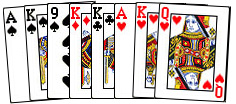
Highest Room
Whose Room counts? Work through these steps in order:
- The team with the Room of the highest Power Order (or most total points, per the table above) counts. If unresolved, go to Step 2.
- If both teams have Room of the same Power Order (e.g. both have a Tears), the Room in Trumps counts. If unresolved, go to Step 3.
- If both teams have Room of the same Power Order and neither is in Trumps, the non-dealing team's Room counts, and the dealing team loses their Room.
Once Highest Room is determined, the Room from both players on the same team counts.
Flag
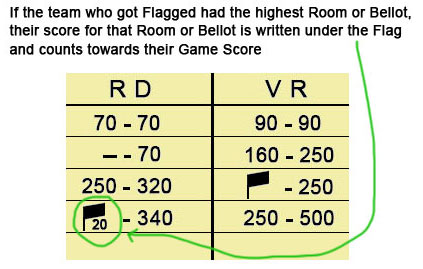
A Flag happens when one team takes all 8 Lifts in a Round — the other team has been Flagged. The Flagging team receives 250 points; the Flagged team gets a small flag mark in their score column.
If the Flagged team had Room, they still receive their Room points.
Scoring a Game
One player at the table keeps score. Any other player may recount the points at the end of a Round to keep the scorekeeper honest.
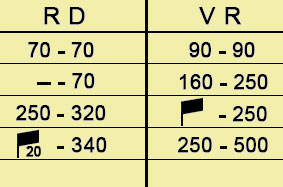
Figures 3 through 8 below walk through the example score sheet section by section.
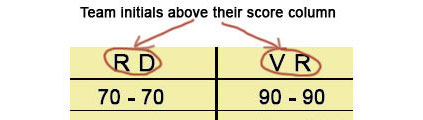
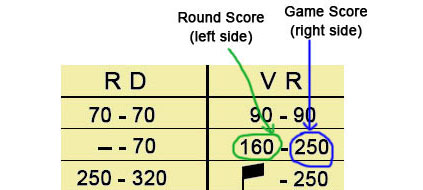
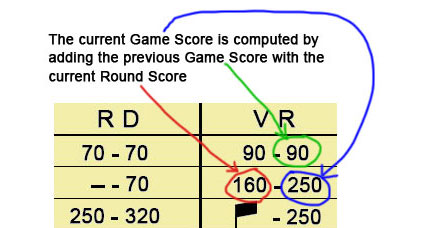
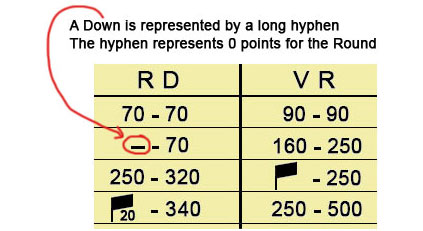
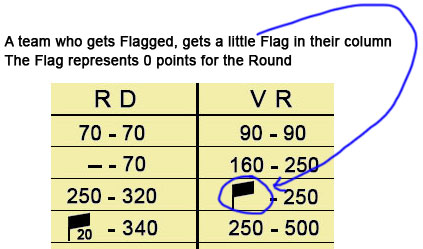
Score Sheet
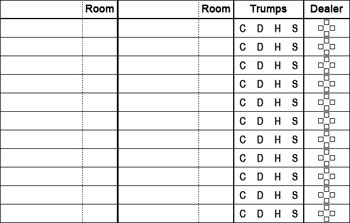
Our score sheet helps the scorekeeper track everything about each Round:
- Columns 1 & 2 track one team's Score and Room.
- Columns 3 & 4 track the other team's Score and Room.
- Column 5 tracks Trumps for the Round — circle C, D, H, or S (Clubs, Diamonds, Hearts, Spades).
- Column 6 tracks the Dealer's position — fill in the box showing the Dealer's seat relative to the scorekeeper.
- The bottom box marks the scorekeeper's own seat at the table.
Large score sheets — 2 per page Small score sheets — 4 per page